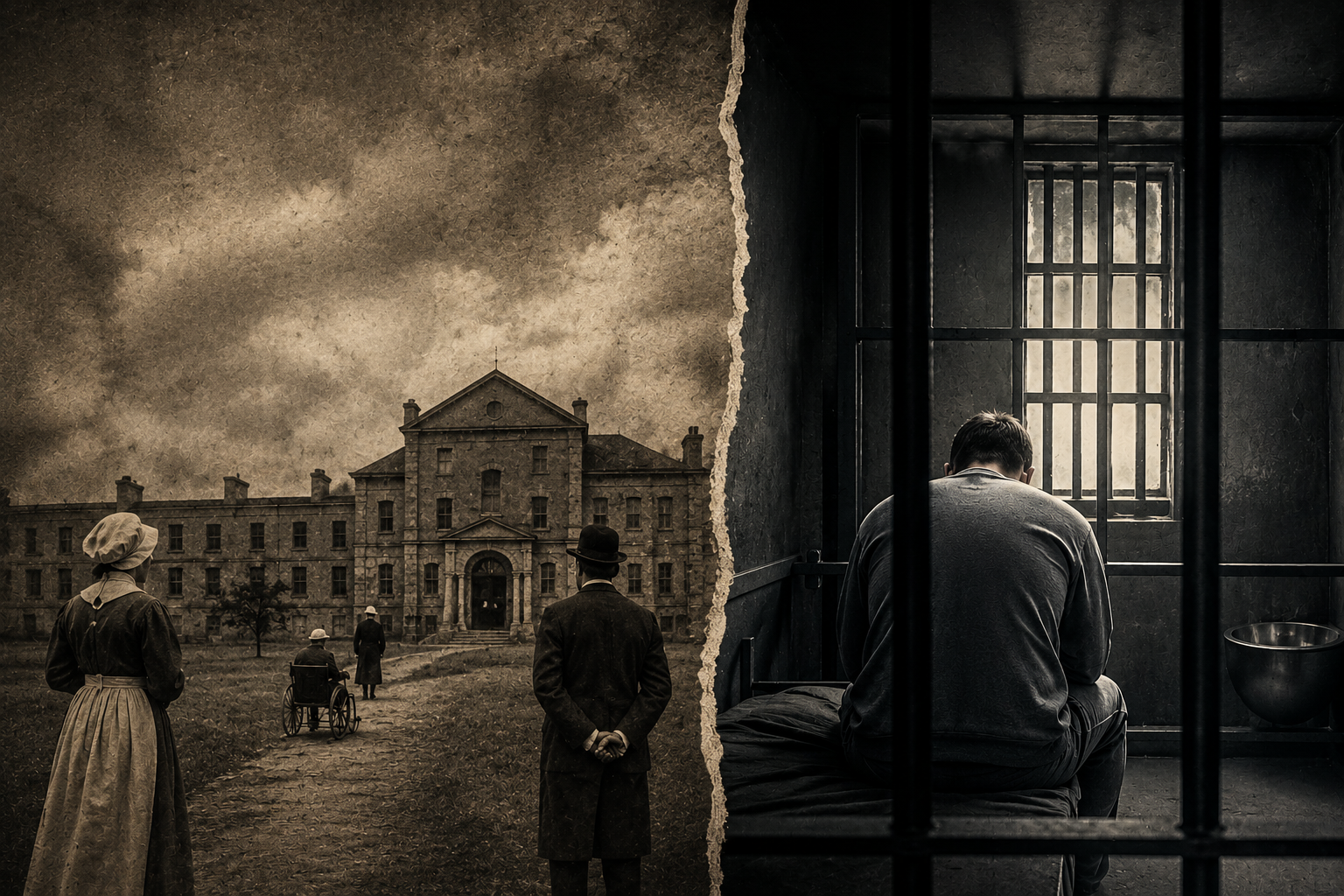
Back to the 1800s: Why the mentally ill are getting jailed, not treated
“I was never diagnosed with a [mental illness], mostly because [in this prison] they don’t diagnose inmates, they just give pills.”
~Ronald, Tayba student
“After I became Muslim [in prison], I struggled with some of the baggage I brought with me into Islam, [especially] my psychological issues. I never sought help for these issues due to what I thought others would think of me, so over time I became depressed. Truthfully without Tayba I might have went insane in this place”
~Justin, Tayba student
“For crying the nurses beat me with a broom-handle and jumped on me. Then they tied my hands and feet, and throwing a sheet over my head, twisted it tightly around my throat, so I could not scream, and thus put me in a bathtub filled with cold water. They held me under until I gave up every hope and became senseless.”
This is an account of a patient at a psychiatric hospital in the US in the 1800s. Needless to say, we’ve come a long way in terms of treating the mentally ill since then.
Or… did we? (warning: the video in the link is disturbing)
The above video is a much more recent example of similar abuse of the mentally ill. Why is it still happening in the 21st century? Read on.
JFK’s last legislation
The barbaric approach to treating the mentally ill that we inherited from the medieval times began to give way to more modern approaches in the 1900s. The big leap came when US President John F Kennedy signed the Community Mental Health Act in 1963, which turned out to be the last piece of legislation that he would sign.
The Community Mental Health Act mandated that old-school, torture-instead-of-treatment institutions be closed and replaced with modern community care centers using the latest approaches: a huge improvement!
Unfortunately, after JFK’s assassination several weeks later, few remained to ensure that the Act would be… well, acted upon. While the old institutions closed down, few of the mandated community care centers opened. Those that were built were underfunded and later defunded under Reagan.
In a short span of time, literally hundreds of thousands of America’s mentally ill were back on the city streets - out of the “torture chambers”, but not taken care of in any meaningful way.
Jails and prisons pick up the slack
In the absence of care facilities, the mentally ill were instead sent to institutions poorly prepared to help them: hospitals and (what’s a lot worse) jails and prisons.
In fact, the biggest care providers for those with mental illness in today’s America are jails, with 2 million mentally ill finding themselves there every year (that’s 15% of all jailed men and 30% of all jailed women). An overwhelming 83% of them do not have access to treatment while in jail.
As for prisons, approximately 10% of inmates (that’s over 200,000 people) are estimated to suffer from a severe psychiatric disorder.
Most would agree that people suffering from an illness should be treated, not incarcerated. Unfortunately, the odds are stacked against a good outcome: there are 10 times more mentally ill people in jails and prisons than in treatment.
Take Tayba’s female students as an example: in our recent survey, 40% report being sexually abused at a young age, and many report witnessing a violent death of a close relative or physical abuse.
This is in line with country-wide statistics, which indicate that 48-88% of female prisoners have been sexually or physically abused prior to prison and suffer from PTSD. Yet our students find themselves behind bars instead of in treatment.
Like pouring gasoline on a fire: what happens with the mentally ill behind bars
In one LA County Jail, mentally ill inmates are held handcuffed and chained to a metal table bolted to the floor, dressed in medieval-looking sleeveless restraints. The jail recognizes that this is containment, not treatment, but there’s simply no programming available to do anything else.
But if you think that’s bad, it gets a whole lot worse: more than 4,000 mentally ill inmates are being held in solitary confinement!
Solitary confinement has been equated with torture by some... and it does terrible things to the mind of a healthy person. For a mentally ill individual, it’s like throwing gasoline on a fire.
Take Ashoor Rasho, an Illinois prisoner who spent more than a decade in solitary confinement and shared his story here. He reports having hallucinations, engaging in self-mutilation, and trying to kill himself while in solitary.
The smallest things would cause him to react violently… so his sentence would be extended for assaulting correctional officers. And so it would go: act out, get a longer sentence, get put into solitary, act out again… and on and on.
But even without solitary confinement, a lack of proper treatment can exacerbate mental illnesses, causing aggressive or inappropriate behavior, leading to further criminalization and harsher punishments.
And it doesn’t go without abuse either. According to Human Rights Watch, mentally ill prisoners are commonly sexually abused, dealt with using excessive force, and sometimes even killed.
Follow the money
As we’ve shown in previous articles, one of the reasons for why the US prison system continues such atrocious mismanagement is the fact that it pays. Every prisoner - mentally ill or otherwise - is a source of revenue for corporations that run these institutions and profit for those who invest in them.
We, the taxpayers, pay an average of $31,000/year per prisoner with a mental condition. This may or may not include prescriptions or any kind of treatment.
Compare this with the cost of actually helping such a person at a community mental care center: $10,000/year.
But why bother? Prisons make money by imprisoning people. And those with mental conditions are their perfect “client”: they stay in prison longer than those without mental illness and are far more likely to wind up incarcerated again upon release.
Helping such individuals actually overcome their illness and become productive members of society would be “bad business”.
Poor re-entry policies
In many states, parolees are required to stay in the area where they lived prior to their arrest: i.e. the place where they fell into crime to begin with, where all their negative influences still live.
Take the story of Tayba student Justin (see video). A successful student, well on his way to become a productive citizen prior to his parole, he nevertheless struggled with mental illness, including OCD.
Upon his release, Justin had to stay in the same neighborhood and he ended up in a house where used needles and feces were everywhere. The stress of trying not to fall back into his bad habits triggered his OCD - and he ended up using easily-available drugs again to deal with the mental strain.
This all came to a head with a psychotic episode that led Justin to try to kill himself and threaten the life of a passer-by, resulting in being thrown behind bars. Again.
In a different community, in different circumstances, he may have reintegrated into free society. But, as hundreds of thousands of people like him, Justin became yet another number in the disaster that is the prison system.
Addressing the symptoms
Much reform is needed, but in the meantime, organizations like the Tayba Foundation are trying to deal with the symptoms.
In the wake of Justin’s re-incarceration, Tayba began to offer life skills courses for those preparing for re-entry. We hope that this new approach will help reduce the number of Tayba students who fail to re-integrate into life in free society.
References:
https://www.talkspace.com/blog/history-inhumane-mental-health-treatments/
https://www.wbur.org/commonhealth/2013/10/23/community-mental-health-kennedy
https://www.therecoveryvillage.com/mental-health/news/criminalization-of-mental-illness/
https://www.treatmentadvocacycenter.org/key-issues/bed-shortages
https://www.npr.org/2020/02/25/805469776/americas-mental-health-crisis-hidden-behind-bars
https://www.newyorker.com/magazine/2009/03/30/hellhole
https://www.hrw.org/news/2003/10/21/united-states-mentally-ill-mistreated-prison
https://www.therecoveryvillage.com/mental-health/news/criminalization-of-mental-illness/